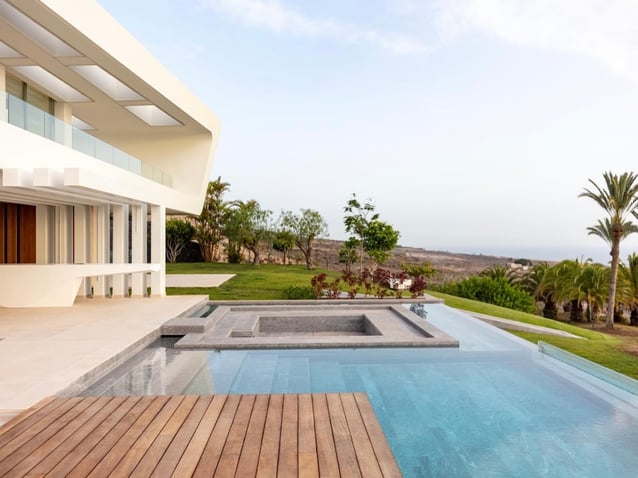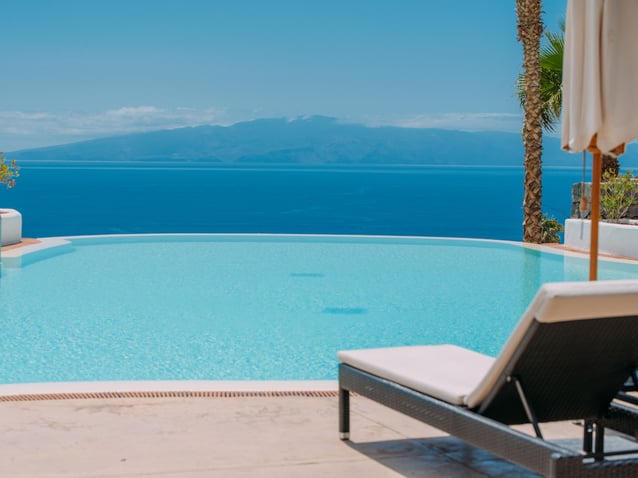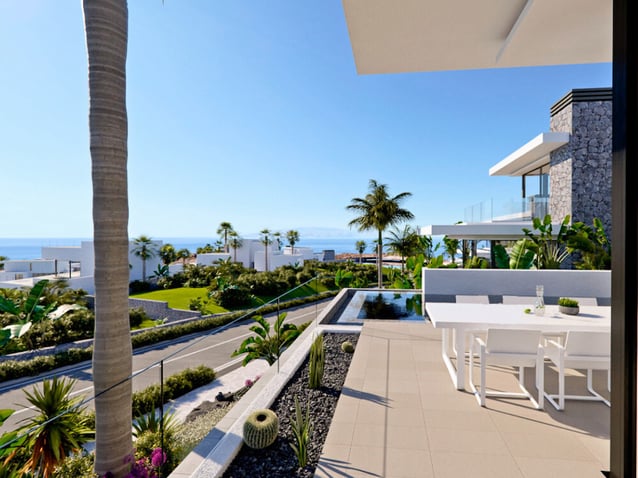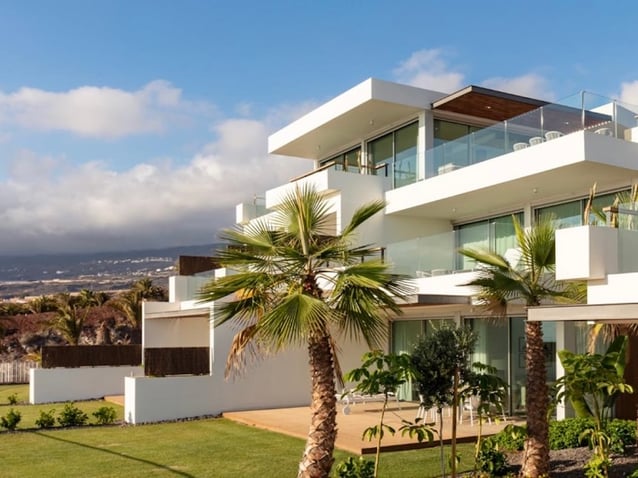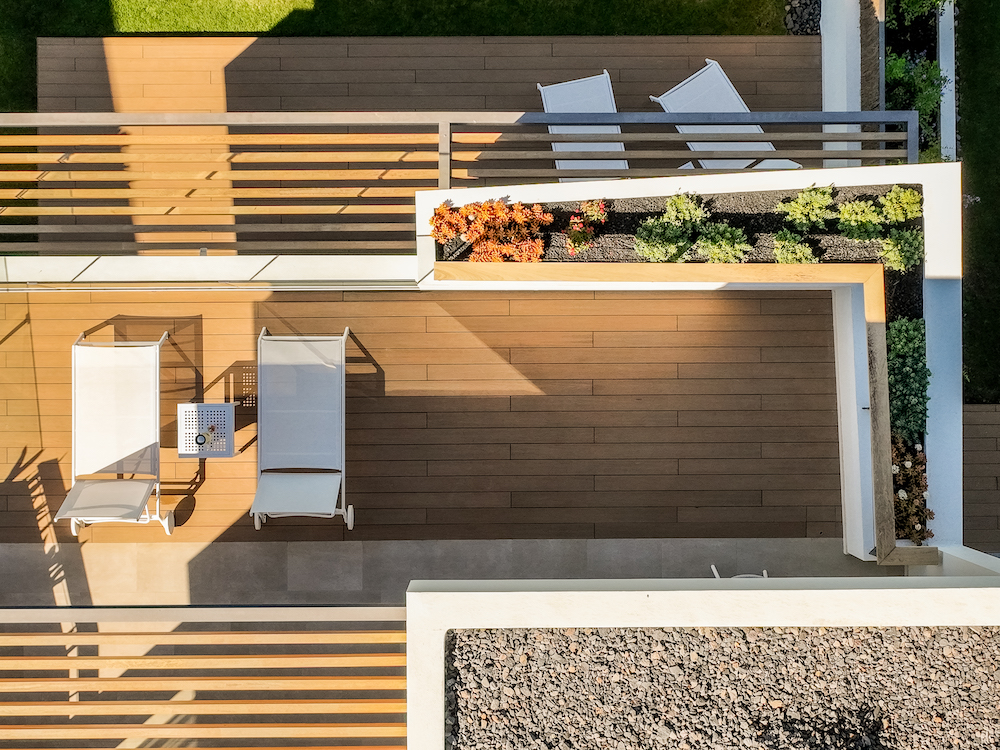
Perfectly integrated into the landscape and making the most of the resort’s natural elevation changes as it descends towards the ocean, the Los Jardines de Abama apartments are striking for their spectacular views and sophisticated design. These tourism-use apartments ideal for personal holidays, investment purposes, or both, offer a dialogue between indoor and outdoor space that has drawn owners from around the world.
Yet these features are not the only aspects of our residences that make them unique. Their location in the Canary Islands and Abama’s commitment to the preservation of its precious natural environment have made sustainable design the foundation of this community. We spoke with Juan Lima of Coderch Urbanismo & Arquitectura studio, the firm behind Los Jardines, diving into some of the primary considerations that shaped this project and all their work at Abama.
Your architectural firm has designed some of Abama's most iconic projects. What role does the resort play among developments in the Canary Islands?
Our firm has been working for Abama since 2011. We have participated in all of the complex's tourism property projects, with the exception of the Ritz-Carlton Abama hotel, which was already completed when we began. Our work includes Las Terrazas de Abama, finished in 2019, and Los Jardines de Abama, which will be completed in 2027, as well as new developments on the horizon for 2026.
Abama is a landmark destination in the Canary Islands and has always been firmly committed to quality tourism, an objective of the Canary Islands government since the late 1980s. Abama’s implementation of these high quality standards acts as a beacon for more quality projects in Tenerife and elevates the island as a destination. It’s to be noted that Abama's commitment to quality has always been unwavering, even in more economically uncertain times; Las Terrazas de Abama was launched in 2011, during a major recession, when many investors had their doubts. And look at it now: it’s an internationally recognized establishment that has won World Travel Awards five years in a row.
The spaces you’ve designed are both hotels and apartments. How do you approach these projects?
The projects we have designed at Abama are special because they are a hybrid between a home and a hotel suite. On the one hand, at Las Terrazas and Los Jardines de Abama, the apartments are more similar in type to a luxury home or villa, as most of them have two, three, or even four bedrooms, with large terraces overlooking the ocean, several en-suite bathrooms, and a fully equipped kitchen. We approach the design of the spaces as if they were a residential complex because we want the owners to feel at home. However, as these are also tourism establishments, they offer hotel services, which means that the buildings’ inner workings are highly complex. They have large communal areas such as gardens and swimming pools with restaurants, service areas required by the hotel operator, and spaces for the community facilities (air conditioning, photovoltaic panels, etc.), that allow for high energy efficiency and benefit sustainability at the resort.
How do you hope Canary Islands and Tenerife architecture will develop over the coming years?
That’s a very interesting question that can be answered a number of different ways. The history of tourism architecture in the Canary Islands is unique. We have some very good examples from the early days of the 1960s and 1970s, with masterpieces like Ten-Bel in Costa del Silencio (Tenerife), by architects Javier Díaz-Llanos, Vicente Saavedra, and Luis Cabrera, and the Hotel Las Salinas in Costa Teguise (Lanzarote), by Fernando Higueras and César Manrique.
However, we then went through a long period in the wilderness, in which it seemed like there was a mutual lack of interest in developing good architecture for tourism, both on the part of the tourism sector and among architectural professionals. Most architecture schools paid little attention to the tourism phenomenon, which didn’t help. Among the projects I did at school, I worked on several houses, a conservatory, a train station, and cultural spaces, but never a hotel.
But I think we can be proud of the work done over the past 15 or 20 years. The increased participation of good studios in the development of tourism-residential areas has significantly raised the average quality of their architecture.
As for the present and future, talent doesn’t concern me, because it’s there, but, like many colleagues, I worry about the state of the public sector. Like many other firms, before we worked for private clients like Abama, we worked extensively for the government on urban planning, subsidized housing, and landscaping for parks, public areas, and seaside spaces. Although we continue to work on urban planning projects for the government, public tenders have been reduced in favor of exponential investment in the government's so-called “in-house resources.” This is lethal for studios, both for the survival of established ones and for the emergence of new talent. Beyond corporate demands, public tenders are vital for maintaining the quality of public architecture. Without them, we would not have gems like Charles Garnier's Paris Opera House or Jørn Utzon's Sydney Opera House.
In our last Owners Cup, Abama celebrated Tenerife's extraordinary relationship with its skies. It’s a relationship familiar to urban planning professionals, but how do architects incorporate the Law of the Skies? How is it reflected in the projects at Abama?
The Law for the Protection of the Astronomical Quality of the Canary Islands Institute of Astrophysics Observatories, better known as the “Law of the Skies,” seeks to preserve the astronomic quality of La Palma and Tenerife by limiting light, radio, and atmospheric pollution. Essentially, the aim is to have darker and “quieter” skies so that the telescopes at the Roque de los Muchachos Observatory, which is as internationally renowned as those in Chile and Hawaii, can perform at their best. Any good lighting designer will tell you that the most common flaw in buildings is light overexposure, which fortunately is limited here by this regulation. This means that projects affected by the scope of the law are designed with subdued outdoor lighting that respects the environment so characteristic of Abama, giving prominence to our sky. As Rafael Moneo said, “Architecture must withstand a careful gaze, but it shouldn’t eagerly impose its presence.”
What challenges does a studio like yours face when it comes to sustainability? What would you say to someone who thinks sustainable construction is just a fad?
Well, we tackle it on several fronts. As urban planners and landscape architects, our studio approaches the environmental assessment of plans through multidisciplinary teams of biologists, geographers, geologists, and other professionals. They provide us with ongoing feedback on sustainability at the regional level. In terms of architectural projects, we also need to keep up to date with the latest technical innovations on the market in terms of architecture and installations. Not only because the legal framework is becoming increasingly demanding in terms of sustainable construction, but also because it’s increasingly important to society as a whole. We’re in the process of obtaining the BREEAM certification for Los Jardines de Abama’s sustainable design.
In addition to architectural projects, your studio is also responsible for the resort's landscaping. How does this work relate to urban planning?
We’ve been drafting urban planning documents at Abama since we began working here. In addition to enabling the development of areas of Abama that were awaiting formal planning approval, we’ve also prepared detailed studies to allow for the construction of Las Terrazas, Los Jardines de Abama, and the upcoming developments. It’s essential to properly adapt the topography of the buildings, using stone terraces, to bring them into harmony with the agricultural landscape of Guía de Isora, which is part of the complex's identity.